
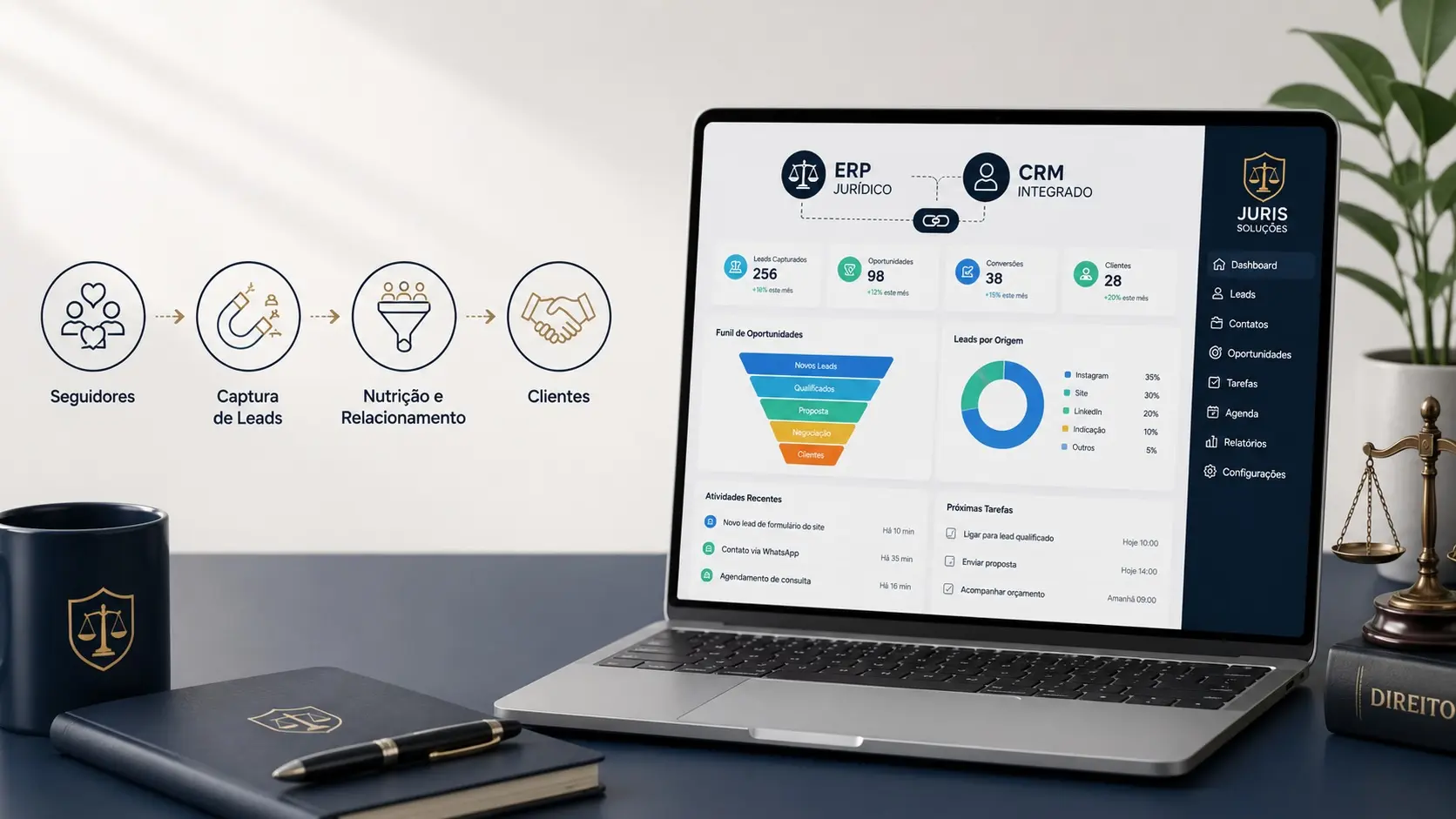
Legal marketing has never been this competitive. Today, a lawyer with a consistent presence on LinkedIn or Instagram can generate a volume of potential clients that would have been unthinkable a few years ago.
The problem shows up straight after, and it is a quiet one: the operation does not keep up. Hundreds of views and private messages count for nothing if the administrative side cannot screen them and reach a proposal in reasonable time. Anyone who has run a practice on spreadsheets, shared inboxes and conversations scattered across several apps knows exactly where the time goes.
The way forward is to route those enquiries straight into a structured legal management system, instead of leaving them to live in the inbox of whoever happened to receive them.
The Flaw of Disconnected Systems
In trying to keep pace with digitalisation, many firms end up with a patchwork. Messaging apps for informal client contact, a spreadsheet to track pending fee proposals, and an ageing case management program for court filing. Each piece works; the combination does not.
When a qualified enquiry arrives, whether a complex corporate matter or a family case, speed and coordination decide almost everything. The hours lost in a fragmented flow are usually enough for the client to pick another firm that, without necessarily being more experienced, answered first.
The biggest barrier to growing a law firm digitally is rarely a shortage of enquiries. It is the absence of a process to work them.
That fragmentation has a concrete, measurable cost: hours of the team's time copying names, emails and case details from one platform to another, work that is not billable and that nobody enjoys doing.
A Legal ERP Unified with CRM
What changes when client acquisition and case management live in the same system? Transcription between platforms disappears, and a single client record exists from the first contact through to the closing of the file.
A custom-built ERP with an integrated conversion module solves four things in practice:
- Centralised capture. Everything that comes in, from the website or social channels, lands in the same visible pipeline. No enquiry is forgotten at the bottom of a direct message folder.
- Faster screening. AI components help separate surface-level questions from matters with real viability, which saves partner time at the stage where it costs most.
- Pre-filled fee proposals. Generated from the data already captured at first contact, instead of re-entering it from scratch.
- Transition without duplication. Once the client signs, the record moves automatically from the commercial stage into the case management side, carrying its full history with it.
How We Work with the Legal Sector
A firm that wants to grow needs a predictable operation, not to react case by case to every spike in workload.
Off-the-shelf management platforms solve part of the problem, but they require several separate subscriptions that do not talk to each other, and it is precisely in the handovers between them that information gets lost. Our team designs unified platforms around the internal dynamics of each practice, covering the client lifecycle end to end.
By connecting commercial contact management to invoicing and case file storage inside the same system, the manual handovers between tools disappear, and that is where nearly all the errors and nearly all the lost time sit.
The point of a system like this is not to add technology to the firm. It is to give the team back the hours currently spent copying information from one place to another.
If your digital efforts are generating enquiries that do not convert because follow-up cannot keep up, the problem is one of process before it is one of technology, and it is worth looking at it in that order.
You can talk to us and we will assess your firm's specific case. The diagnosis is free, carries no commitment, and we answer within 48 business hours.